Chemical class
A water-soluble vitamin in the B-complex family, structurally unique for containing cobalt at the center of a corrin ring. This cobalt center is what allows B12 to shuttle methyl groups in enzyme reactions.
Vitamin B12 (cobalamin) is a water-soluble vitamin the human body cannot manufacture, so every microgram you carry comes from diet, supplements or injection. Oral B12 depends on a stomach protein called intrinsic factor, and once that pathway is saturated or impaired, pills quietly stop working. IV delivery routes B12 straight into the bloodstream and skips the absorption problem entirely.

Vitamin B12, known chemically as cobalamin, is a water-soluble B vitamin built around a cobalt atom held inside a corrin ring. It is unusual among vitamins because it is produced only by certain bacteria and archaea, not by plants or animals, which is why dietary B12 comes almost exclusively from animal foods such as meat, fish, eggs and dairy, or from fortified products. The liver can store several years of B12 in a healthy adult, but that reservoir depletes quietly in people with absorption problems, restrictive diets or long-term acid-suppressing medication use. Once absorbed, B12 is converted into two active coenzymes, methylcobalamin and adenosylcobalamin, which drive reactions the body cannot complete without it.
A water-soluble vitamin in the B-complex family, structurally unique for containing cobalt at the center of a corrin ring. This cobalt center is what allows B12 to shuttle methyl groups in enzyme reactions.
Found almost exclusively in animal foods: beef, liver, clams, salmon, tuna, eggs and dairy. Plant foods contain essentially no bioavailable B12, which is why vegetarians and vegans are the classic at-risk group.
The liver can hold a two to five year reserve of B12 in healthy adults, but that reserve is invisible on standard bloodwork until it is nearly gone. Symptoms of depletion often lag the actual deficiency by months or years.

After IV administration, B12 binds to transport proteins called transcobalamins that carry it through the plasma to cells throughout the body.
Inside cells, B12 is converted into methylcobalamin in the cytoplasm and adenosylcobalamin in the mitochondria. These are the forms enzymes actually use.
Methylcobalamin donates methyl groups to build DNA and neurotransmitters, while adenosylcobalamin helps mitochondria convert fatty and amino acids into usable energy.
Because B12 is water soluble, any amount the body cannot store or use is filtered by the kidneys and excreted in urine, which is why the safety margin is very wide.

B12 sits at the center of two enzyme systems the body cannot run without. When it is low, red blood cells, nerves and energy metabolism all suffer in a predictable sequence.
B12 is a required cofactor for the enzyme methionine synthase, which is essential for DNA synthesis in rapidly dividing cells. Bone marrow depends on this pathway to build normal red blood cells. Without enough B12, precursor cells cannot divide properly and instead swell into large, immature megaloblasts, producing the classic megaloblastic anemia that leaves patients pale, breathless and profoundly tired.
Adenosylcobalamin, the mitochondrial form of B12, is required by methylmalonyl-CoA mutase to process certain fatty acids into energy. When this reaction stalls, methylmalonic acid accumulates and interferes with the production of myelin, the insulating sheath around nerve fibers. Long-standing B12 deficiency causes numbness, tingling, balance problems and, in advanced cases, permanent neurological damage called subacute combined degeneration of the spinal cord.
B12 works alongside folate to convert homocysteine into methionine, a reaction that also regenerates active folate and supports the methylation cycle. This cycle drives ATP production and hundreds of downstream reactions, from neurotransmitter synthesis to hormone regulation. Low B12 leaves patients feeling flat, foggy and fatigued in ways that no amount of sleep resolves.
By clearing homocysteine, B12 helps keep this amino acid at a healthy blood level. Elevated homocysteine is a well-established marker of cardiovascular and cognitive risk. Adequate B12, folate and B6 together keep this pathway running.
The methylation reactions B12 drives are also involved in producing serotonin, dopamine and norepinephrine. Chronically low B12 can present as low mood, poor concentration and irritability long before a formal anemia shows up on a complete blood count.

Subclinical B12 deficiency is far more common than the frank anemia most people associate with it. Symptoms often build slowly over months, and patients typically attribute them to age, stress or poor sleep before they consider B12.
A heavy, unrefreshing tiredness that does not improve with sleep and often worsens through the afternoon.
Difficulty holding a thought, losing words mid sentence, or feeling mentally slower than usual.
Pins and needles or a subtle burning sensation, particularly in the feet, is one of the earliest neurological signs.
Because B12 supports neurotransmitter production, low levels can flatten mood and shorten the fuse without an obvious external cause.
Signs that megaloblastic anemia may be developing, as red blood cell production falters.
A red, inflamed or unusually smooth tongue, sometimes with a burning quality, is a classic exam finding in B12 deficiency.
Intravenous B12 bypasses the stomach, the intrinsic factor pathway and the ileum entirely. The full dose enters circulation at once, saturates plasma binding proteins and delivers cobalamin directly to the tissues that need it, regardless of gut health. B12 absorption is one of the most complicated in human nutrition. It requires stomach acid, a pancreatic enzyme, and a stomach protein called intrinsic factor that binds B12 and carries it to specific receptors in the terminal ileum. That entire chain must work for a pill to deliver a meaningful dose.
IV B12 delivers 100 percent of the labeled dose into the bloodstream.
There is no absorption calculation, no intrinsic factor requirement and no dependence on gastric acid.
B12 moves from plasma into the liver and peripheral tissues after infusion.
How individual patients respond varies.
For patients with pernicious anemia, gastric bypass, Crohn disease, celiac disease or long-term acid suppression, IV or intramuscular B12 is the only reliable way to restore levels.
Oral supplementation simply cannot get past the absorption block.
Because absorption is not a variable, dose response is consistent.
Your nurse and the medical director can plan a schedule with confidence rather than guessing what fraction of a pill made it into circulation.
The active absorption system in the terminal ileum saturates at roughly 1.5 to 2 mcg per meal.
Beyond that, you are relying on slow passive diffusion across the intestinal wall, which captures only about 1 percent of what you swallow.
Older adults, patients on long-term proton pump inhibitors or metformin, and anyone with pernicious anemia, celiac disease or a history of gastric bypass surgery have impaired intrinsic factor or ileal absorption.
For these groups, oral B12 can be nearly useless regardless of dose.
IV B12 transforms cobalamin from a vitamin that is barely absorbed at high oral doses into a fully bioavailable therapeutic dose delivered in a single visit.

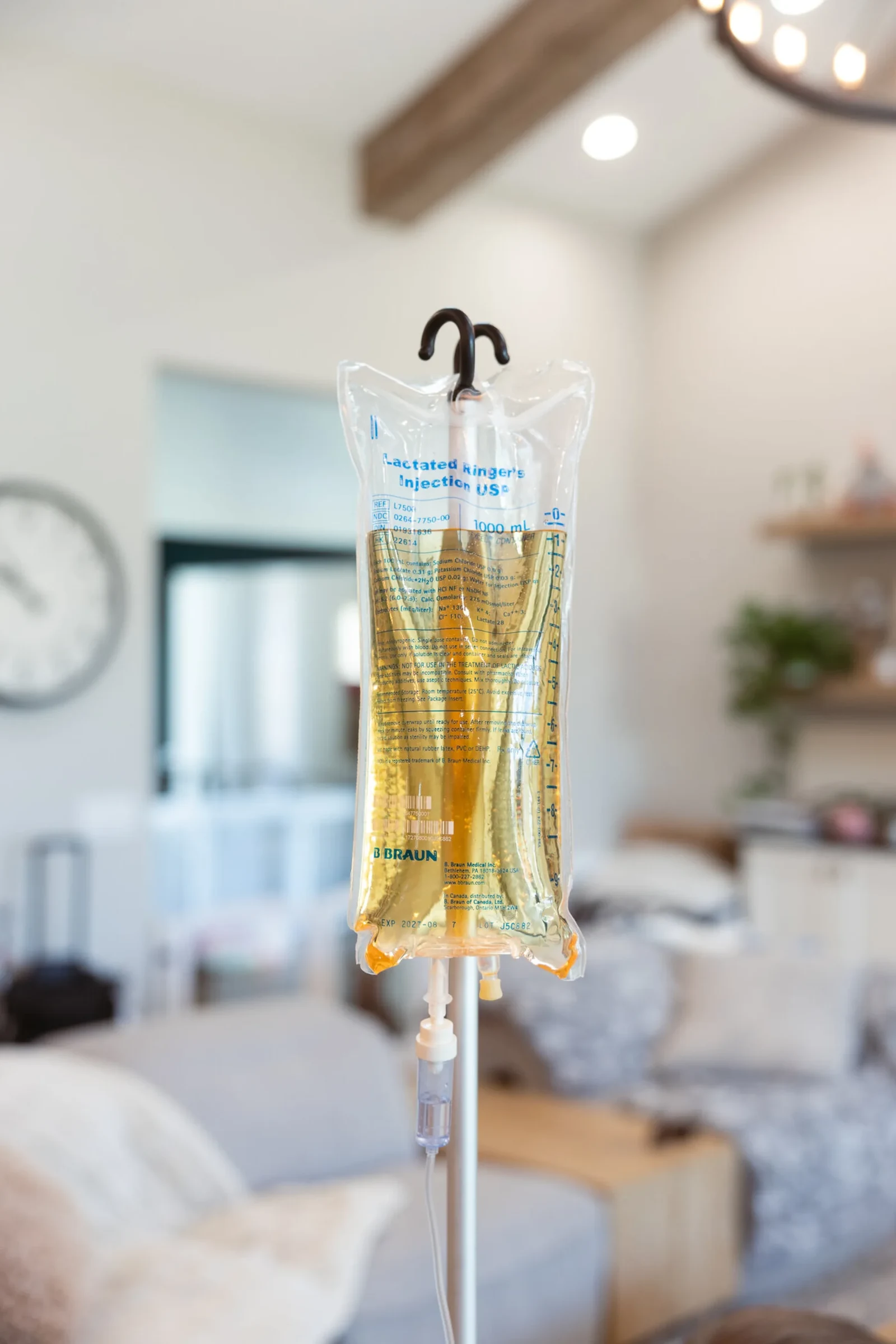
Vitamin B12 is built into several standard drips and can be added to any treatment for $25. Scan the table for the tier that fits your goal.
Includes B12 as part of the base formula. A solid mid-tier drip for general recovery, fatigue and rehydration.
Includes B12 alongside a full B-complex, magnesium and vitamin C. The most complete methylation and energy support in the standard menu. Members pay $160.
Includes B12 to support energy and nervous system recovery after alcohol depletion, alongside fluids.
Includes B12 alongside 4,000 mg vitamin C, zinc and other immune cofactors. Chosen when patients are fighting off illness or preparing for travel.
B12 can be added to Replenish IV or any other treatment on the menu as a single $25 add-on.
The lowest cost way to receive B12 is to add it to a Replenish IV. The most complete methylation support comes from the Renew IV (Myers Cocktail), and Immunity Booster is the pick when B12 is wanted alongside high-dose vitamin C.
B12 rarely works alone in the body. The following ingredients appear alongside it in IV Revival drips for good biochemical reasons.
B12 shares the methylation cycle with folate, B6 and riboflavin. Pairing B12 with a full B-complex ensures every step of homocysteine clearance and energy metabolism has the cofactors it needs. This is why the Renew IV (Myers Cocktail) includes both.
Magnesium is a cofactor for hundreds of ATP-dependent reactions, including several that B12 feeds into. When patients feel fatigued, low magnesium and low B12 often coexist, and treating one without the other leaves the picture incomplete.
Vitamin C supports adrenal function and immune activity, both of which draw on the same energy pathways B12 sustains. Together they are a common pairing for patients recovering from illness or heavy physical stress.
Glutathione is the body's master intracellular antioxidant, and its synthesis depends on methylation reactions B12 helps drive. Combining the two puts both in the same visit.

Vitamin B12 has one of the widest safety margins of any nutrient. It is water soluble, and any excess the body cannot use is filtered by the kidneys and cleared in urine. There is no established upper limit for B12 intake, and toxicity from supplementation has not been reported in healthy adults.
Patients with significant renal impairment should discuss dosing with their physician, as clearance of any infused substance is slower when kidney function is reduced.
A rare genetic eye condition where high-dose cyanocobalamin is contraindicated. Patients or families with this history should tell the nurse before treatment.
Because B12 contains a cobalt atom, patients with a known cobalt allergy should avoid it and let the intake nurse know during scheduling.
Some patients notice a brief warm flush, a mild metallic taste or slight tenderness at the IV site. These are transient and resolve quickly.
Long-term use of metformin, proton pump inhibitors and some anticonvulsants can affect B12 status. This makes the reason for supplementation more important, not the safety of it.
Every IV Revival protocol is developed and overseen by a board-certified anesthesiologist medical director, Dr. Drew Davenport, and every treatment is placed by an experienced Registered Nurse who reviews your history before starting the infusion.
The Revive IV at $175 carries a B12 push alongside a full B-complex. The Renew IV (Myers Cocktail) at $220 and the Hangover Helper at $225 both include it as well. It can be added to any other drip for $25.
Swallowed B12 has to be absorbed with the help of a stomach protein called intrinsic factor, which plenty of adults are short of, and absorption drops further with age and with some medications. An IV puts it into the bloodstream directly, so none of that applies.
Yes, for $25. Your registered nurse draws it up on site from company-supplied stock rather than handing over something pre-packed.
A registered nurse comes to your home, hotel or office anywhere within 40 miles of Scottsdale with no travel fee, reviews your history, takes your vitals and stays for the whole drip. Booking runs 9 AM to 9 PM, seven days a week.

Mobile IV across the Phoenix metro
Registered Nurses only, mixed on site, delivered to your home or hotel across Phoenix, Scottsdale, Gilbert, Mesa, Chandler, Tempe, Glendale, Paradise Valley, Fountain Hills, Peoria, Ahwatukee and Avondale, seven days a week from 9 AM to 9 PM.