Magnesium IV Therapy in Phoenix

Magnesium is the fourth most abundant mineral in the human body and a required cofactor in more than 300 enzymatic reactions. Your body cannot produce it, and modern diets consistently fall short of the daily requirement. Oral magnesium is limited by tolerance and absorption; an IV route places it directly into circulation without that ceiling.

Mobile IV therapy across the Phoenix metro, placed by Registered Nurses only.
A registered nurse in black scrubs and pink gloves drawing up a vial on a sunlit Phoenix patio

What Is Magnesium?

Magnesium is an alkaline earth metal that functions as an essential dietary mineral in humans. In the body it exists mostly as the divalent cation Mg2+, with roughly 60 percent stored in bone, about 39 percent inside soft tissue and muscle cells, and less than 1 percent circulating in serum. Because serum levels are tightly regulated, a normal blood test can hide significant intracellular depletion. There is no long-term reserve pool that the body can draw from freely, so consistent daily intake matters.

Chemical form

Magnesium in clinical use is delivered as magnesium sulfate or magnesium chloride, both of which dissociate into free Mg2+ ions in circulation. The sulfate form is the standard for intravenous administration and has decades of hospital use behind it.

Where it lives in the body

About 99 percent of total body magnesium is intracellular, concentrated in bone, muscle and soft tissue. Only a small fraction circulates in serum, which is why symptoms of depletion can appear even when a routine blood panel looks normal.

Where it comes from

Dietary sources include leafy greens, nuts, seeds, whole grains and legumes, but soil depletion and refined food processing mean the average adult intake sits well below the recommended 310 to 420 mg per day.

The IV Revival nursing team of four registered nurses in black scrubs, outdoors on a Phoenix patio

How Magnesium Is Delivered at IV Revival

Every treatment is mixed on site from company-supplied stock by a Registered Nurse. Nothing arrives pre-packed, and no EMTs, paramedics or technicians place lines at IV Revival, ever.

  • Mixed on site

    Your nurse prepares the drip in front of you from stock supplied by the company. This preserves stability and lets the dose be tailored within protocol.

  • Placed by a Registered Nurse

    IV access is placed by an experienced RN. IV Revival was founded in 2016 by two Nurse Anesthetists and has kept that staffing standard since day one.

  • Protocols set by a physician

    Protocols are developed and overseen by Dr. Drew Davenport, a board-certified anesthesiologist and the medical director for IV Revival.

A registered nurse looking up as she checks the drip rate on the stand, in black and white

What Magnesium Actually Does in Your Body

Magnesium is a silent partner in nearly every energy-producing and signaling process. When it runs low, many systems begin to misfire at once rather than one obvious system failing.

ATP energy production

Every molecule of ATP, the cellular energy currency, is biologically active only when bound to magnesium as Mg-ATP. Without adequate magnesium, mitochondria cannot efficiently convert food into usable energy. This is why persistent fatigue is one of the earliest signs of depletion. Enzymes involved in glycolysis and the citric acid cycle also require magnesium as a cofactor.

Neuromuscular signaling

Magnesium acts as a natural calcium channel modulator at the neuromuscular junction. Calcium triggers muscle contraction; magnesium allows the muscle to relax afterward. When the ratio tips toward calcium dominance, muscles cramp, twitch and remain tense. This mechanism explains the classic use of IV magnesium for calf cramps, eyelid twitches and tension held in the jaw and shoulders.

Vascular smooth muscle and blood pressure

The same relaxation effect applies to the smooth muscle lining blood vessels. Adequate magnesium supports vasodilation and normal vascular tone. This is one of the mechanisms behind its role in headache and migraine protocols, where cerebral vessel constriction is part of the picture.

Nervous system regulation

Magnesium regulates NMDA glutamate receptors in the central nervous system, acting as a natural gatekeeper against overexcitation. It also supports GABA activity, the primary calming neurotransmitter. Low magnesium is associated with a nervous system that feels wired, restless and unable to settle.

Electrolyte and hydration balance

Magnesium works in concert with potassium, sodium and calcium to maintain the electrolyte gradients that drive nerve conduction and cardiac rhythm. It is required for the sodium-potassium pump to function correctly. Dehydration, heavy sweating in the Arizona heat, and alcohol all deplete magnesium alongside the more obvious electrolytes.

Common Signals to Watch For

  • Night cramps
  • Eyelid twitch
  • Tension headache
  • Migraine
  • Restless legs
  • Poor sleep
  • Jaw clenching
  • Anxious tension
  • Post-workout soreness
  • Heat exhaustion
  • Hangover
  • PMS cramps
A woman in sunglasses resting on a patio daybed, her forearm dressed and the line taped in place partway through a treatment

Signs You Might Be Low on Magnesium

Muscle cramps and twitches.

Calf cramps at night, eyelid flutters and hand tremors are classic early signs of low magnesium.

Tension headaches and migraines.

Recurrent headaches, especially those with a tight band quality or a migraine pattern, correlate strongly with low magnesium status.

Poor sleep and difficulty relaxing.

A wired-but-tired feeling, difficulty falling asleep and light waking sleep often improve when magnesium is restored.

Fatigue that rest does not fix.

Because magnesium is required for ATP to function, low levels leave you feeling drained even after a full night in bed.

Jaw clenching and shoulder tightness.

Chronic muscle guarding, TMJ tension and knots between the shoulder blades often reflect a calcium to magnesium imbalance.

Heart palpitations or a fluttery pulse.

Magnesium is essential for cardiac electrical stability. Skipped beats and palpitations in an otherwise healthy person can signal depletion and warrant medical evaluation.

Why IV Magnesium Is Different

An intravenous infusion places magnesium sulfate directly into venous circulation, bypassing the gut entirely. There is no transporter to saturate and no bowel to irritate. Serum levels rise predictably and reach concentrations that oral dosing simply cannot achieve. Oral magnesium is absorbed in the small intestine through a mix of active transport and passive diffusion. Both routes saturate quickly, and any unabsorbed magnesium pulls water into the bowel, which is exactly how magnesium is used as a laxative. The result is a hard ceiling on how much you can take by mouth before the gut objects.

Dietary range

Normal serum magnesium sits around 1.7 to 2.2 mg per deciliter.

Read moreShow less

This range covers baseline enzymatic function but leaves little margin for stress, heat loss or increased demand. Achievable through diet alone in a well-fed person.

Mid range with oral supplementation

Consistent oral supplementation can nudge serum levels toward the upper end of normal and slowly rebuild intracellular stores.

Read moreShow less

This is appropriate for long-term maintenance.

High oral ceiling

Even at maximum tolerated oral dosing, serum magnesium rarely climbs beyond the upper normal range because renal excretion tightens as intake rises.

Read moreShow less

Bowel tolerance caps the input before blood levels shift meaningfully.

Pharmacological range via IV

IV magnesium sulfate can transiently raise serum levels above the oral ceiling, which is the range at which vascular smooth muscle relaxation, bronchodilation and neuromuscular calming effects become clinically observable.

Read moreShow less

This is the range used in migraine and severe cramp protocols.

Intracellular repletion

Because IV delivery maintains a high serum concentration gradient, magnesium moves into cells more readily than oral protocols allow.

Read moreShow less

Results vary from person to person.

Active transport saturation

The TRPM6 transporter that handles active magnesium uptake in the gut saturates at low doses.

Read moreShow less

Anything beyond its capacity has to rely on slower passive diffusion, which is inefficient and easily overwhelmed.

Bowel tolerance

Unabsorbed magnesium is osmotically active and draws water into the intestine.

Read moreShow less

This is the mechanism behind magnesium citrate as a laxative. It also puts a firm ceiling on how much oral magnesium anyone can take without GI symptoms.

IV magnesium is a direct path from depleted to replete. It does not replace long-term dietary intake, but it resets the baseline in a single visit.

When Magnesium IV Therapy Makes Sense

  • During an active migraine
  • After heavy training
  • Post heat exposure
  • The morning after drinking
  • During high-stress weeks
  • With persistent muscle cramps
  • Before or during travel
  • As part of a monthly reset
A hanging IV bag beside a snake plant, in black and white — the kit set up and waiting

Which IV Revival Packages Contain Magnesium

Magnesium appears in several drips on the IV Revival menu, at different doses. Scan the list below to find the right fit.

Migraine Relief IV, $190

Carries a double dose of magnesium, targeted at active migraine and severe tension headache.

Renew IV (Myers Cocktail), $220

Classic Myers formula with magnesium alongside B vitamins and vitamin C. A well-rounded reset.

Immunity Booster, $325

Includes magnesium plus 4,000 mg of vitamin C and additional immune support nutrients.

Magnesium add-on, $25

Can be added to any drip on the menu, including the Replenish IV at $150, Revive IV at $175 and Hangover Helper at $225.

Membership pricing

The $39 per month membership drops the Renew IV to $160, a straightforward way to get magnesium and the full Myers formula on a regular schedule. Three-month minimum, then cancel any time.

The lowest cost route to IV magnesium is the Replenish IV at $150 with the $25 magnesium add-on. The highest magnesium dose sits in the Migraine Relief IV.

Magnesium Works Better With These Ingredients

Magnesium rarely works alone. It is a cofactor for other vitamins and pairs naturally with the electrolytes lost alongside it.

B-Complex vitamins

The B vitamins depend on magnesium as an enzymatic cofactor for their role in energy metabolism. Pairing magnesium with a B-Complex add-on supports the ATP cycle from both sides, which is why the Renew IV (Myers Cocktail) combines them.

Vitamin B6

B6 improves magnesium transport into cells. The two are commonly used together for premenstrual symptoms, muscle tension and nervous system regulation.

Vitamin C

Both are lost more rapidly under stress and illness. Vitamin C supports vascular integrity while magnesium supports vascular relaxation, a useful pairing during recovery from viral illness or heavy training.

IV fluids and electrolytes

Rehydration with normal saline restores volume; magnesium restores the mineral that sweat, alcohol and stress have quietly stripped out. The two together explain why a simple hydration drip with magnesium can produce such a rapid shift in how someone feels.

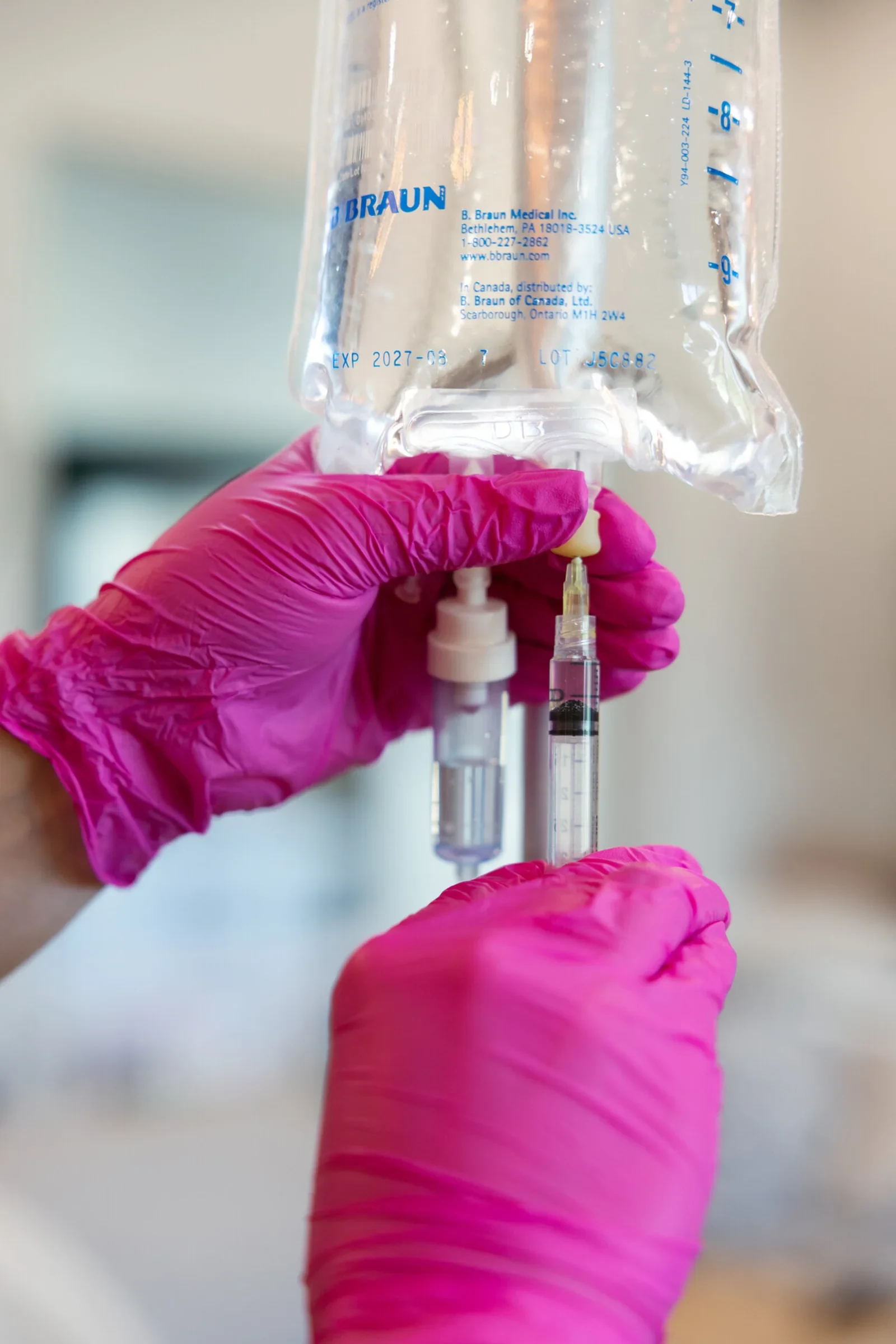
Gloved hands adding vitamin pushes to a one-litre bag before it goes up on the stand

Magnesium Safety and Who Should Ask First

Magnesium given intravenously is well tolerated by most healthy adults, and a warm flush during the infusion is common and expected. Your registered nurse controls the rate and stays with you for the whole visit, which is part of why the double dose in the Migraine Relief IV is given as an appointment rather than something you set up yourself. Tell your nurse about kidney problems, heart rhythm conditions, any medication you take, and whether you are pregnant or breastfeeding. Protocols are written and overseen by our medical director, Dr. Drew Davenport, a board-certified anesthesiologist. IV therapy is elective and is not a substitute for care from your own physician or for emergency treatment.


Frequently Asked Questions

How much magnesium is in a typical drip?

The amount varies by drip. The Renew IV (Myers Cocktail) and Immunity Booster contain a standard therapeutic dose, and the Migraine Relief IV carries a double dose targeted at active headache. As a $25 add-on, magnesium can also be layered onto any drip on the menu. Your nurse can walk you through the exact protocol before the infusion starts.

How often should I get magnesium IV therapy?

For general maintenance, once a month is a common cadence and pairs well with the $39 monthly membership, which drops the Renew IV to $160. For active symptoms such as migraine or heavy training loads, more frequent visits can be appropriate. Long-term repletion is best supported by consistent dietary intake between IV sessions.

Can I get too much magnesium?

In healthy people with normal kidney function, the risk from a single properly dosed IV is very low. The kidneys efficiently clear any excess. The concern rises in people with kidney disease, certain heart rhythm conditions or specific medications, which is why every patient is screened before treatment and monitored by a Registered Nurse throughout.

Is IV magnesium better than oral supplements?

Better is situational. Oral magnesium is appropriate for long-term daily maintenance and is inexpensive. IV magnesium is the right tool when you need rapid repletion, when oral dosing has hit bowel tolerance without symptom relief, or when a specific event such as a migraine or heavy dehydration calls for a therapeutic serum level. Many people use both.

Will magnesium help with my headache today?

Magnesium is a well-established component of migraine and tension headache protocols. Many people report meaningful relief within the infusion itself, particularly when the drip pairs magnesium with fluids and nausea support. Results vary by person and by the underlying headache type, and IV therapy is not a substitute for evaluation of new or severe headaches by a physician.

A registered nurse going through the health history with a client seated on her own sofa, the IV stand ready beside them

Delivered across the Phoenix metro

Restore Your Magnesium the Right Way

Open 9 AM to 9 PM, seven days a week.

CallBook now